Board-game AI / Research archive / Download desk
Games, research & downloads
A working archive for dozens of trained games and rule experiments. Findings stay separate from files: each entry tells you what is known, what can be downloaded, where the exact source lives, and whether models, datasets, rules, or clients are public.
Archive key
Five columns, five different promises
A source branch is not automatically a downloadable product, and a self-play result is not a proof. The archive keeps those distinctions visible.
- Finding / status
- What current experiments support, with uncertainty stated where needed.
- Download / release
- A packaged engine, model, client, or bundle that can be downloaded.
- Source
- The exact repository or branch used for this game.
- Dataset / model
- Published training data or model collections.
- Rules / paper / play
- Rule references, papers, interfaces, and related notes.
Download first
Current published builds
Use this shelf when you want something runnable. The detailed catalog below adds source, data, rule notes, and research findings.
“Current” means the latest public build recorded here as of July 13, 2026. Open the tag page for packaged files and release-specific notes.
Full archive
Find a game or a kind of resource
No entries match this search and filter.
01 / Go
Go training & rule variants
The main line covers CNN and Transformer training, inference, public models, and self-play data. The remaining rows isolate rule experiments from downloadable builds.
| Game / project | Finding / status | Download / release | Source | Dataset / model | Rules / notes / play |
|---|---|---|---|---|---|
| Go training line | Active research line CNN and Transformer training plus an ONNX / TensorRT inference path. |
— | — | ||
| 3D Go / Lizzie3D | Published build Supports 5×5×5 and 7×7×7. Release notes say whole-board seki is common and current testing places balanced komi around 1; these are observations, not solved-game results. |
3d_go_20260620 | — | The package includes the ONNX-DirectML engine, model, and a matching Lizzie3D workflow; a TensorRT build can be compiled separately. | |
| Capture Go | Published build The first player to capture an opposing stone wins. |
CaptureGo_20250509 | CaptureGo2024 | — | — |
| Kill-all Go | Published build A life-and-death variant centered on killing the target group. |
LifeGo_20241025 | LifeGo2024 | — | — |
| Hex Go | Source branch Go rules on a hexagonal grid. |
— | HexGo2024 | — | — |
| No-adjacent move Go | Source branch A move cannot be played next to the immediately previous move. |
— | GoModify2a | — | — |
| Hex Capture Go | Source branch Capture Go on a hexagonal grid. |
— | HexCaptureGo | — | — |
| Weighted-area Go | Source branch Areas or stones use different scoring weights. |
— | weightGo | — | — |
| Reverse capture | Source branch When a group has no liberties, the current player's stones are removed first. |
— | FirstCaptureMe | — | — |
| Four points per capture | Research branch One captured stone scores four points, making captures much more valuable than in ordinary Go. |
— | yiziqianjin | — | — |
| No legal move loses | Research branch A related scoring experiment can be read as no pass: the first player without a legal move loses. |
— | Same branch notes | — | — |
| aliveWin | Research branch White wins after capturing one black stone; Black wins when one fully connected group is alive. Branch notes suggest Black can often live. |
— | aliveWin | — | — |
02 / Gomoku
Gomoku, NNUE & rule variants
KataGomo is the main packaged line in this family. NNUE work, three-dimensional games, and exploratory rules remain independently traceable.
| Game / project | Finding / status | Download / release | Source | Dataset / model | Rules / notes / play |
|---|---|---|---|---|---|
| KataGomo | Published build Supports freestyle, overline-does-not-win, Renju, and Caro rules. Public desktop build dated 2025-02-06. |
Gomoku_20250206 | Gom2024 | — | Zhizi Gomoku mobile client |
| Gomoku NNUE | Research branch An early design in the line that led toward Rapfi NNUE, focused on efficient CPU inference. |
— | gomoku_nnue | — | NNUE paper |
| Caro | Included in main build Caro win rules are included in the public KataGomo package. | Gomoku_20250206 | Caro2024 | — | — |
| Pente | Published build Win by making five or by meeting the capture condition. | Pente_20250726 | Pente2025 | — | — |
| 3D Connect-N / Lizzie3D | Published build Includes connect-six, exact-six, connect-seven, and axis-only connect-five on 11³ or 13³ boards. Ordinary 3D Gomoku is not in this release. | 3d_gomoku_20260620 | — | ONNX-DirectML engine, models, and a matching 3D interface are packaged together. | |
| Banned-point Gomoku | Source branch Some intersections are unavailable for play. | — | GomBanLoc | — | — |
| Endpoint-five Gomoku | Source branches The move completing five must land at an endpoint of the line. | — | — | — | |
| Double-line Gomoku | Source branch Uses a nonstandard two-line connection structure. | — | newgame_DifLineGomoku | — | — |
| Mo Qi | Source branch After two free moves, legal points depend on the odd/even count of black stones along rows, columns, or diagonals; five wins. | — | newgame_MoQiGomoku | — | — |
| Five-line counting | Source branch Scores the number of completed five-in-a-row lines instead of ending at the first one. | — | fiveCount | — | — |
| Capture Gomoku | Source branch Combines connection and capture objectives. | — | capture_gomoku | — | — |
| Arithmetic-progression six | Source branch The six target stones occupy an arithmetic progression rather than consecutive points. | — | EquDifGomoku | — | — |
| Orthogonal connect four | Historical branch unavailable Only horizontal or vertical four counts. First player has a simple win, although selected openings remain nontrivial. | — | — | — | — |
03 / Hex
Hex
KataHex has a runnable package, its exact training branch, and a public dataset.
| Game / project | Finding / status | Download / release | Source | Dataset / model | Rules / notes / play |
|---|---|---|---|---|---|
| KataHex | Published build Public build dated 2025-01-31. | Hex_20250131 | Hex2024 | KataHex_2024 | — |
04 / Connect6
Connect6
The package includes KataConnect6 and an opening book; the source and NNUE experiments are linked separately.
| Game / project | Finding / status | Download / release | Source | Dataset / model | Rules / notes / play |
|---|---|---|---|---|---|
| KataConnect6 | Published build Current models suggest Black is likely winning: a win within 55 moves on 19×19 and within 45 moves on 25×25. These are model-based findings, not solved-game proofs. | ConnectSix_20260406 | — | The release includes the opening book. |
05 / Ataxx
Ataxx
KataAtaxx publishes the ONNX engine, Transformer model line, and training data as distinct resources.
| Game / project | Finding / status | Download / release | Source | Dataset / model | Rules / notes / play |
|---|---|---|---|---|---|
| KataAtaxx | Published build In recorded 7×7 model self-play, the first-player win rate is about 57%. | Ataxx_20260501 | Ataxx-onnx | KataGo_Ataxx_202604 | — |
06 / Connect Four
Connect Four
The runnable build and exact source are separated from the board-size outcome matrix.
| Game / project | Finding / status | Download / release | Source | Dataset / model | Rules / notes / play |
|---|---|---|---|---|---|
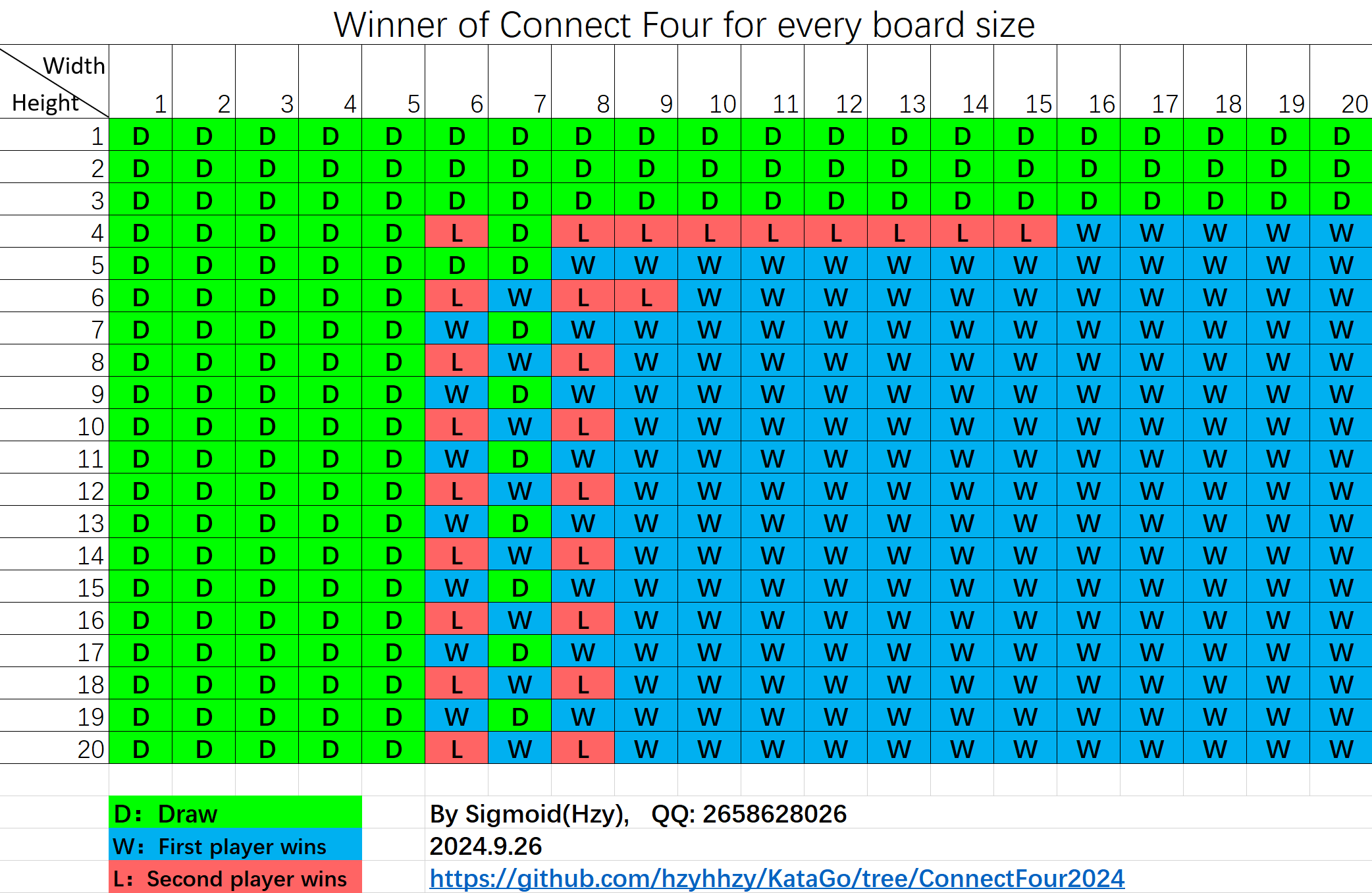
| Connect Four AI | Published build Preliminary outcomes are recorded for board sizes up to 20×20; the full equivalent text follows the image. | ConnectFour_20241019 | ConnectFour2024 | — | View result matrix |
Show equivalent text
Rows are board heights and columns are widths. D means draw, W means first-player win, and L means second-player win.
- Heights 1–3 are draws at every width; widths 1–5 are draws at every height.
- At height 4: widths 6 and 8–15 are second-player wins, widths 16–20 are first-player wins, and the rest are draws.
- At height 5: widths 1–7 are draws and widths 8–20 are first-player wins.
- At even heights 6–20: widths 6 and 8 are second-player wins, width 7 and widths 9–20 are first-player wins, and widths 1–5 are draws; the lone exception is 6×9, also a second-player win.
- At odd heights 7–19: widths 1–5 and 7 are draws, while width 6 and widths 8–20 are first-player wins.
07 / Animal Chess
Animal Chess
The interface package, engine source, and training dataset are maintained separately.
| Game / project | Finding / status | Download / release | Source | Dataset / model | Rules / notes / play |
|---|---|---|---|---|---|
| Animal Chess AI | Published build Current model self-play suggests standard Animal Chess is very close to a draw. | Dandelion v3.1 | AnimalChess2025 | katago-animalchess-2025 | Dandelion provides the playable interface and AI package. |
08 / Chinese Checkers
Chinese Checkers
A runnable build and training branch are available; the result remains a model-based experimental observation.
09 / Mathematical games
Mathematical games & search problems
The same training framework has been used to explore the Angel Problem, a connect-seven proof attempt, Dawson's Chess, and Escape Go.
| Game / project | Finding / status | Download / release | Source | Dataset / model | Rules / notes / play |
|---|---|---|---|---|---|
| Mathematical-game experiments | Research branch Exploratory work; no standalone public program is currently listed. | — | AngelProblem | — | Googology |
10 / More games
More games, original rules & historical branches
This table is intentionally dense but predictable: conclusions stay in the second column, files in the middle columns, and rule references or interactive notes at the end.
| Game / project | Finding / status | Download / release | Source | Dataset / model | Rules / notes / play |
|---|---|---|---|---|---|
| NoGo | Published build On 9×9, the recorded initial first-player win rate is about 90%. |
Nogo20250219 | Nogo2025 | katago-nogo-2025 | |
| Amazons | Published build On 10×10, the recorded first-player win rate is about 70%. | 20240406 | Amazons | — | Rules |
| Breakthrough | Published build On 8×8, the current model result is close to a forced first-player win. | Breakthrough_20250616 | Breakthrough2025 | — | |
| Reversi | Research branch In this experiment, the KataGo-based route underperformed mature traditional Reversi programs. | — | Reversi2023 | — | Rules |
| Ultimate Tic-tac-toe | Published build Without tiebreaker: 21% first-player wins, 2% second-player wins, 77% draws. With tiebreaker: 78%, 4%, and 18% respectively. | UltimateTictactoe_20250616 | UltimateTictactoe2024 | — | Rules |
| Score Four | Published build A three-dimensional connect-four experiment. | ScoreFour_20250510 | ConnectFour3d | — | Rules |
| Dots and Boxes | Source branch A line-drawing combinatorial-game experiment. | — | DotsAndBoxes | — | Rules |
| Quoridor | Source branch A wall-placement racing-game experiment. | — | Quoridor2024 | — | Rules |
| Surakarta | Source branch An experiment with the traditional Indonesian capture game. | — | Surakarta | — | Rules |
| Clobber | Source branch A combinatorial-game experiment. | — | Clobber2023 | — | Rules |
| Anti-connect five / four / three | Source branch The first player to complete the target line loses. | — | AntiConnectN2025 | — | |
| Zhen Qi | Published build An original Nijie-system game in which adjacent stones may be pushed outward after a move. | Zhenqi20250218 | ZhenQi | — | |
| Xing Qi | Source branch An original Nijie-system symmetry-scoring game. | — | newgame_XingQi | — | |
| King's Move Connect 4 | Source branch A non-gravity connect-four variant constrained by king-move adjacency. | — | con4type1 | — | |
| Nijie's AntiGomoku | Source branch An original anti-Gomoku game that combines placement with moving an opposing stone. | — | newgame_gomokuamazons | — | |
| StarsZone | Source branch Each turn places one own stone and optionally one limited neutral ban point. After 16 stones each, relation patterns score; fewer neutral bans break a tie. | — | StarsZone | — | — |
| Xiangqi | Not open source Branch notes report that PX0 performed clearly better. | — | — | — | Rules |
| Chess | Historical branch unavailable An early small-scale test; no branch is retained here. | — | — | — | Rules |